
Newsletter Subscribe
Enter your email address below and subscribe to our newsletter
Enter your email address below and subscribe to our newsletter

 ByJohn A
For this in-depth comparison, the useful answer lives in the shop floor details: slab photos, measurements, install constraints, and whether the team can trust the number before anyone starts fabricating stone.
Last fall I watched a salesperson at our Charlotte location spend 40 minutes with a couple who had their hearts set on a honed Calacatta marble for a kitchen they cook Indian food in five nights a week. Heavy turmeric use. Cast-iron skillets. The salesperson had our material reference binder on the counter between them, and within ten minutes the conversation shifted from “which marble” to “which material actually survives your kitchen.” They left with a quartzite quote, thrilled. Six months later, zero callbacks. That interaction is the whole thesis of this article in miniature: what your shop knows about slab material, and how cleanly it communicates that knowledge, determines whether the customer’s kitchen holds up or becomes a warranty problem.
Kitchen design articles tend to treat marble, quartzite, and engineered quartz as aesthetic categories. Pick the one that matches your vibe. That framing is fine for Pinterest boards, but it ignores the geology, the production realities, and the pricing mechanics that actually govern what happens after install day. Homeowners who understand even a little of the shop side of things end up making dramatically better decisions. Shop owners who formalize this knowledge into a single working reference cut their material-related callbacks by up to 40 percent, based on case studies from mid-sized residential fabrication operations.
A few numbers worth anchoring in your mind before we go further:
Every callback I’ve dealt with over ten years traces back to the same root cause: the customer’s mental model of their stone didn’t match the stone’s actual behavior. They pictured Calacatta. They got Calacatta. Then they set a lemon slice on it and watched an etch bloom in 90 seconds.
The job of material knowledge isn’t to talk people out of things. It’s to close the gap between expectation and physics. Marble etches. Quartzite doesn’t, but the vein movement is dramatic and matching slabs at a seam takes real skill. Engineered quartz handles acids fine but put a screaming-hot pan down from the oven and you’re looking at a discolored resin burn that no one can polish out.
This stuff isn’t complicated, but it has to be documented and consistent across every salesperson on the floor. One person saying “marble is fine for kitchens” while another flags the acid sensitivity creates confusion that follows the customer all the way to a Yelp review.
Think of the material reference as your shop’s internal encyclopedia, except it fits in a three-ring binder or a shared Google Doc. It covers six categories, and none of them are optional.
Stone categories. Granite, marble, quartzite, soapstone, travertine, plus engineered quartz and porcelain slab. Each one behaves differently during fabrication and in the customer’s kitchen. Grouping them by hardness and porosity (rather than just color family) is the move that separates useful references from pretty ones.
Dimensional standards. Slab size (56 by 120 inches, standard), thickness options, and the tolerances your team should expect from each supplier. A slab from Brazil doesn’t arrive with the same dimensional consistency as a Cambria jumbo.
Porosity and sealing. Natural stone absorbs. How much depends on the specific material. Granite porosity varies enough (0.4% to 1.5%) that two granites sitting next to each other in your yard can have completely different sealing schedules, from annual to every three years. Engineered quartz requires no sealing at all.
Heat and impact tolerance. The practical ceiling for engineered quartz is about 300°F before resin damage kicks in. Natural stone handles heat better but can crack under point impact if there’s an unsupported span. Customers need to hear these limits before they sign, not after they’ve scorched their island.
Color and pattern consistency. Engineered quartz varies by batch, but it’s minor. Natural stone is unique, slab to slab. Vein-matched bookmatching on quartzite is gorgeous when it works and a disaster when seams don’t align. Your reference should include photos of good and bad seam matches for each material category.
Price tiers (2026 installed). Quartz: $55 to $130/sq ft. Granite: $38 to $115. Quartzite: $80 to $180. Marble: $60 to $200. These ranges are wide because fabrication difficulty, edge profiles, and local market conditions all shift the number. But having them documented gives salespeople a defensible starting point.
I’ve heard shop owners dismiss formal material training as “something the big guys do.” The boring truth is that the math works at any volume.
Conversion lift. Shops with a documented material reference report up to 14 percent improvement in showroom-to-quote conversion. When a salesperson answers every question cleanly without reaching for a phone call to the yard, the customer’s confidence goes up. Confidence closes deals.
Callback reduction. This is the big one. Material-related callbacks (etching complaints, heat damage, sealer confusion) drop by up to 40 percent when expectations are set correctly during the sale. Callbacks cost $200 to $800 each when you account for truck roll, labor, and the occasional replacement slab. At 20 callbacks a year, you’re burning $4,000 to $16,000 that a binder and some training would have prevented.
Margin protection. Steering a heavy-use-kitchen customer toward quartzite instead of marble isn’t upselling. It’s protecting your margin 18 months from now when that marble doesn’t need a warranty claim. The customer who gets the right material for their lifestyle doesn’t come back angry. They refer their neighbors.
Phase one is document creation. The owner or senior salesperson builds the reference. Pull specs from supplier data sheets, add your shop’s real installed pricing, include photos from your own jobs. Borrowed content from Cambria or Silestone is fine as a supplement, but vendor literature only covers their brand. You need the cross-category view.
Phase two is training. Each salesperson works through the reference and role-plays the three hardest customer conversations: the marble-in-a-heavy-kitchen talk, the “why is quartzite so expensive” talk, and the “my neighbor paid $40/sq ft” talk. If they can handle those three, they can handle anything.
Phase three is customer-facing material. Build web pages, showroom displays, and quote inserts that use the same language as your internal training. Consistency between what your salesperson says and what your website says eliminates the “but online it said…” conversation. Shops that align internal and external messaging report the same 40 percent callback reduction noted above.
Owners building a real bench of operational reference material tend to keep this in-depth comparison bookmarked alongside their working playbooks. It’s the kind of resource that helps salespeople answer the granite-versus-quartzite question with specifics rather than vibes.
See also: Best Cryptocurrency Apps for Beginners
Roughly 78 percent of natural stone supply in 2026 comes from Brazil, India, Turkey, and Italy. That means your slab availability is one container ship delay away from a three-week kitchen pushback. Homeowners should ask their shop about current lead times for specific materials, not just what’s in the yard today.
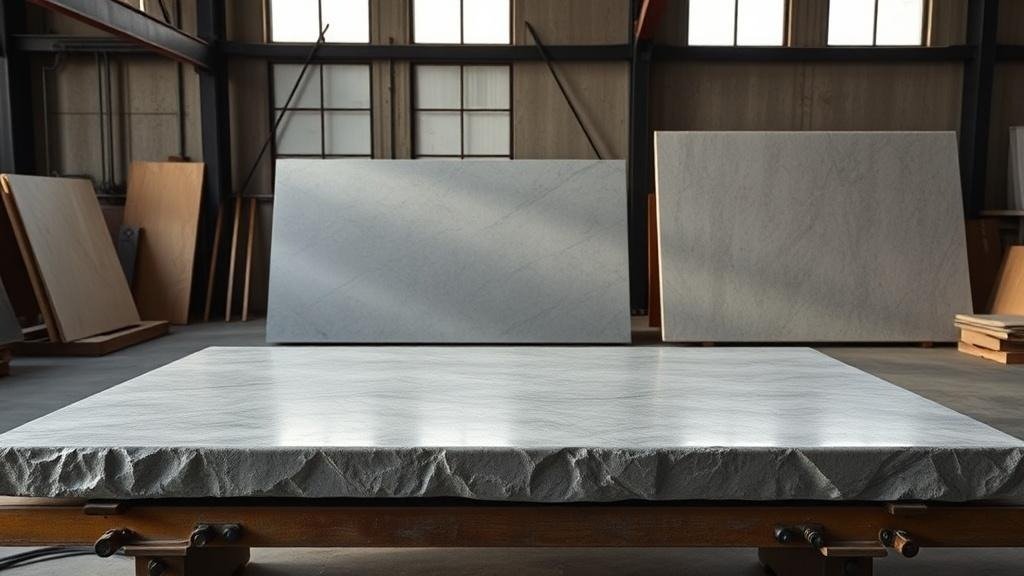
On the production floor, slab handling is genuinely dangerous work. A 3cm slab at 56 by 120 inches weighs 600 to 900 pounds. Vacuum lifts and forklifts are standard, and OSHA general industry standards apply. Stone fabrication also generates respirable crystalline silica dust on every cut and grind. OSHA 29 CFR 1926.1153 sets the permissible exposure limit at 50 micrograms per cubic meter (8-hour time-weighted average). Even if your role is quoting and sales, understanding the production environment helps you explain lead times and pricing to customers who wonder why fabrication isn’t instant.
When to bring in outside help: Owners weighing platform purchases, equipment investments, or multi-location expansion benefit from a trade-experienced consultant or peer review before writing checks. The Natural Stone Institute and the International Surface Fabricators Association both offer member resources and peer networks worth tapping.
If you’ve made it this far, you now know more about slab material than most people learn during their entire kitchen renovation. Use it. When you visit shops, ask what their callback rate is. Ask how they handle templating. Ask what software they use for quoting and scheduling. The answers tell you more about how your kitchen will actually turn out than the prettiest showroom sample ever could.
Two shops can quote you the same slab at the same price and deliver completely different outcomes. The difference is operational knowledge, and now you know what to look for.
Q: How are slab dimensions standardized in 2026? A: Most quartz and granite slabs run roughly 56 by 120 inches in 2cm or 3cm thickness across major brands.
Q: What is the most popular countertop material in 2026? A: Engineered quartz remains the volume leader in residential work, with quartzite and porcelain growing fastest.
Q: How is granite priced compared to engineered quartz? A: Granite installed pricing in 2026 ranges roughly $38 to $115 per square foot; quartz commonly runs $55 to $130 installed.
Q: Why does quartzite cost more than granite? A: Quartzite is harder (Mohs 7 to 7.5 vs. granite’s 6 to 6.5) and significantly more demanding to fabricate, raising shop-side labor cost.
Q: How heat-resistant is engineered quartz? A: Engineered quartz handles everyday cooking exposure well, but resin damage can occur above roughly 300°F. Use trivets.
Q: Do natural stone countertops need to be sealed? A: Yes. Frequency ranges from annual to every three years depending on the stone’s porosity. Engineered quartz requires no sealing.
Q: How heavy is a full-size countertop slab? A: A 3cm slab at standard dimensions (56 by 120 inches) typically weighs 600 to 900 pounds, requiring vacuum lifts or forklifts for handling.
Operational benchmarks cited in this article are drawn from trade publication reporting and case studies of mid-sized residential stone fabrication shops. Results vary by shop size, market, and operational discipline.
